Showing posts with label MYSTERY. Show all posts

Tuesday, February 2, 2016

Scientists May Have Just Figured Out Why Time Moves Forward, Not Backwards

photo credit: Time flies like an arrow, fruit flies like a banana.
Griffith University Associate Professor Joan Vaccaro has put forward a suggestion on why there’s a difference between the future and the past. According to her calculations, the laws of physics don’t have to distinguish between time and space, but since we don't experience time in the same way as space, something must make time different. And she thinks the answer is in a special class of quantum phenomena.
Certain quantum phenomena don’t behave in the same way if you’re going forward or backward in time, and she suggested that these are the key to understanding the arrow of time – the "asymmetry", or one-way direction, of time. And she said that in particular, subatomic particles known as K and B mesons could provide some interesting information. Her research is published in the Proceedings of The Royal Society A.
“If you want to know where the universe came from and where it’s going, you need to know about time,” Vaccaro said in a statement.
“Experiments on subatomic particles over the past 50 years show that nature doesn’t treat both directions of time equally. In particular, subatomic particles called K and B mesons behave slightly differently depending on the direction of time.”
Here's an analogy: If you leave a cup of coffee on the table you’d expect it to stay there. Sure, maybe you can move it around on the table, but it would still be a cup on a table. If the cup started flickering in and out of existence, you’d think something really weird was going on.
The flickering of the cup is not something we experience because it would violate the conservation of mass, but if space and time are truly two sides of the same coin, then it should be allowed to happen. And as an object is limited in space (it has got a size and a position), they could also be limited in time (they could appear and disappear).
“In the connection between time and space, space is easier to understand because it’s simply there," she added. "But time is forever forcing us towards the future.
“Yet while we are indeed moving forward in time, there is also always some movement backwards, a kind of jiggling effect, and it is this movement I want to measure using these K and B mesons.”
Professor Vaccaro reworked the equations of quantum mechanics in a way that the conservation of mass wasn’t a given condition of the universe. She thus discovered that time and space did truly behave identically in that scenario. Even more interestingly, once violations of symmetries are allowed, the equations evolved into the ones that describe our universe and the law of conservation of mass arises organically from this theory.  
“Understanding how time evolution comes about in this way opens up a whole new view on the fundamental nature of time itself," she said. "It may even help us to better understand bizarre ideas such as travelling back in time.”

Wednesday, January 13, 2016

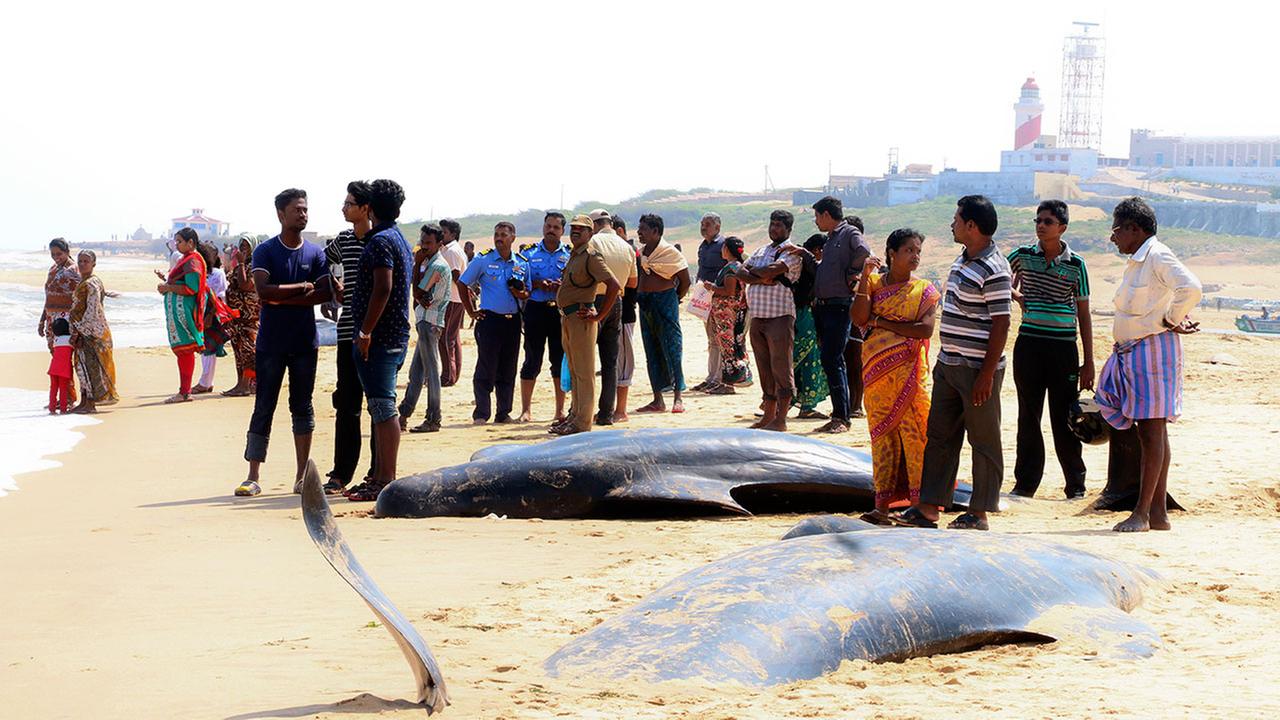
Reasons Behind Why Whales Stranded On Tamil Nadu’s Coast

33Image Courtesy: chennaiplus
What happened to the whales in Tamil Nadu?
About 81 short-finned whales had beached near Mandapu village since Monday evening. The area is around 600 km south of Chennai in Tutucorin district. Fishermen battled hard to try to put them back into the water in vain.
The administration is investigating into the cause of such large scale stranding of whales. Initial reports suggest Earthquake to be the most plausible reason.
11Image Courtesy: mshcdn
Former director of Zoological Survey of India, K Venkataraman has said “On Monday, an earthquake with a magnitude of 6.5 on the Richter scale and another one measuring 6.9 on the Richter scale were in the Philippines and Indonesia, respectively. These could have disoriented the whales.”
Why do whales strand onshore?
Whales behave strangely when they become weak, contract disease, when their usual migration patterns get disturbed when their ecosystem is invaded and for many other causes listed below. Once faced by the below-mentioned interference, the whales which moves in pack gets disoriented and eventually ends up getting stranded onshore only to die.
Natural causes:
1.) Like Earthquakes-causes the whales to get disoriented.
2.) Stranding happens when the whales contract any diseases, if they are weak and hence they let the waves take control of these majestic swimmers.
Man made causes:
The collision of ships, fishing nets injuring them, pollution of the ocean water, change in temperatures of water due to release of industrial effluents, sound of ships, usage of sonar devices in the ocean.
44Image Courtesy: abclocal
Where else has it happened?
It has happened in multiple locations across the world including California where whales have got stranded and died. The stranded whales do not return to the waters as if it is on a suicidal mission. In almost all the past instances the whales which got stranded to the shore have died on the shore.
77Image Courtesy: cbsla | San Pedro
Some of the countries where this phenomenon is common includes:
1.) New Zealand – Hundreds of pilot whales died by stranding on the shores of New Zealand. The reason cited being the underwater sonar systems used by the military which disorients the whales and send them on a suicide mission.
88Image Courtesy: The Guardian
2.) South Africa – Hundreds of killer whales had stranded on the coast of South Africa in 2009.
All the whales which got stranded died.
99Image Courtesy: scienceworldreport
Both in New Zealand and South Africa, the whales were given euthanasia to reduce their prolonged sufferings.
Do’s and Don’ts
According to Marinemammalcenter.org, these are the steps to be followed in case of stranding of marine organisms
1. Don’t touch and do not pick up, pour water on or feed the animal
They are wild animals and can bite. They also are easily stressed by humans.
2. Do not return the animal to the water
Seals and sea lions temporarily “haul-out” on land to rest. Harbor seal mothers often leave their pups ashore while they’re feeding at sea. A beached whale, dolphin, or porpoise should be reported immediately.
3. Observe
Observe the animal from a distance of at least 50 feet. Keep people and dogs away.
4. Describe
Note physical characteristics such as size, presence of external earflaps, and fur color. This helps us determine the species, what rescue equipment, and volunteers are needed.
5. Condition
Note the animal’s condition. Is it weak and underweight? Are there any open wounds?
6. Identification
Does the animal have any obvious identification tags or markings?
7. Location
Determine the exact location of the animal in order to provide accurate directions. We cannot rescue an animal if we cannot find it!
8. Call the nearest wildlife office who are trained to handle such a situation.
A detailed study required
All the coastal countries more particularly the countries which has witnessed stranding of whales should come together to sponsor a joint study that can confirm the reasons for the whales stranding onshore.
The Logical Indian commends the valiant efforts of the fishermen who tried to save the whales.
Preventive measures
It is quite evident human interference is a major cause of whales stranding and dying onshore. Presence of military equipment which uses sonar, dumping effluents & other substances which causes temperature changes & kills fishes which are potential meals for whales should be avoided. Judicial usage of fishing nets & careful navigation of ships should be prioritized.
The CRZ regulations should be enforced in its word and spirit. Natural calamities like earthquake also cause this phenomenon, however, we as a society could and should do our part in safe guarding the marine ecosystem.
Source : THE LOGICAL INDIAN

Wednesday, October 14, 2015

Nehru Wrote to Kennedy for Help in 1962 War With China, Says New Book

Nehru Wrote to Kennedy for Help in 1962 War With China, Says New Book
According to the book, Jawaharlal Nehru's letter was hand delivered by the then Indian Ambassador to the US K Nehru to President Kennedy on November 19.
WASHINGTON:  Former Prime Minister Jawaharlal Nehru had sought American assistance and wrote to the then US President John F Kennedy to provide India fighter jets to stem the Chinese aggression during the 1962 Sino-India war, according to a new book.

The main objective of Mao Zedong, the founding father of the People's Republic of China, to attack India in 1962 was to "humiliate" Mr Nehru who was emerging as a leader of the third world, the book said.

"India's implementation of the Forward Policy served as a major provocation to China in September 1962," Bruce Riedel, a former CIA official, wrote the book titled 'JFK's Forgotten Crisis: Tibet, the CIA and the Sino-Indian War'.

"Mao's focus was on Nehru, but a defeat of India would also be a setback for two of Mao's enemies: (Nikita) Khrushchev and Kennedy," Mr Riedel wrote.

As India was losing its territory to China fast and suffering heavy casualty, Mr Nehru in a letter to US President Kennedy in November 1962 said India needed "air transport and jet fighters to stem the Chinese tide of aggression."

"A lot more effort, both from us and from our friends will be required."

Mr Nehru wrote another letter to Mr Kennedy in quick succession, Mr Riedel writes. Mr Nehru's letter was hand delivered by the then Indian Ambassador to the US K Nehru to President Kennedy on November 19.

"Nehru was thus asking Kennedy to join the war against China by partnering in an air war to defeat the PLA (Peoples Liberation Army of China). It was a momentous request that the Indian Prime Minister was making. Just a decade after American forces had reached a cease-fire with the Chinese Community Forces in Korea, India was asking JFK to join a new war against Community China," Mr Riedel wrote in his book.

Ahead of Mr Nehru's letter, the then US Ambassador to India Galbraith sent a telegram to the White House giving the President Kennedy an advance notice that such a request was coming from Mr Nehru.

In the letter, Mr Nehru asked for 12 squadrons of US air forces, Mr Riedel told the Washington audience during the preview of the book at an event organised by the Brookings Institute -a top American think-tank - yesterday.

"A minimum of 12 squadrons of supersonic all weather fighters are essential. We have no modern radar cover in the country. The United States Air Force personnel will have to man these fighters and radar installations while our personnel are being trained," Mr Nehru wrote in the letter, which has been quoted by Mr Riedel in the book.

In addition, Mr Nehru also requested "two squadron of B-47 Bombers" to strike in Tibet, the author says quoting the letter.

In the letter, Mr Nehru assured Mr Kennedy that these bombers would not be used against Pakistan, but only for "resistance against the Chinese".

The stakes were "not merely the survival of India", Mr Nehru told Mr Kennedy "but the survival of free and independent Governments in the whole of this subcontinent or in Asia".

Source : NDTV

Wednesday, October 7, 2015

NETAJI SUBHASH CHANDRA BOSE DEATH MYSTERY

‘Netaji was not dead but in Russia, and the govt knew it’

It’s been 65 years since Independence, yet one of the greatest mysteries of India about freedom fighter Subhas Chandra Bose endures. Did he die in a plane crash? Or did he survive but not tell his tale! Akrita Reyar of Zeenews.com found out more from well known journo and author Anuj Dhar, who has recently released his book: ‘India’s Biggest Cover Up’. 

Your book ‘India’s Biggest Cover Up’, as the name suggests, blows the lid off one of the best kept secrets of Modern India. Tell us about it? 

The book is the result of a decade-long, focused research into the question of Netaji’s fate — something that has haunted generations of Indians all over the world. It takes an objective look at all the plausible scenarios and offers the reader clear conclusions and insights based on sound reasoning and unimpeachable source material. In brief, I have deduced that there are only but three possible explanations of what happened to Bose. One, as the official version goes, he was killed following an air crash in Taipei three days after his benefactor Japan decided to surrender to the Allies. Two, he did not die in Taipei because he was in the USSR after August 1945. Three, he was possibly in India in the guise of a holy man. 

After going into all these theories with a fine tooth comb I have arrived at conclusions, some of which are even legally tenable. One, the air crash theory was just a smokescreen created by Bose and his Japanese friends, especially Field Marshal Count Hisaichi Terauchi, commander of the Japanese forces in South East Asia. Netaji knew that if he remained in Japan-controlled territory after the surrender, he would be arrested by the Anglo-Americans and tried as a war criminal. He was told by his aides that his capture would end the Independence movement as at that time only he was carrying out what we can call “struggle” for freedom. Two, all that has come on record makes it clear that Netaji was USSR-bound at the time his death was announced. With the available leads it would be fair to deduce that Bose was in Russia after August 1945. Three, the holy man angle is trickier than most people, especially the intelligentsia and historians, think. Beginning 1960s rumours, whispers and claims became rife in India that Netaji was alive in India as a holy man. The phenomenon was sought to be explained by some as nothing but government trickery to trivialize the issue and throw the public off the scent of Russian angle. But my findings are at variance. I have reasons to believe that the possibility of Bose being in India was indeed very real. 
How difficult was it to research such a book and how convinced are you of the leads? 

‘India’s Biggest Cover Up’ couldn’t have been written by any of the celebrated historians for the simple fact that there’s hardly any source material available in public domain. The subject matter of Netaji mystery falls into the domain of government secrecy and, therefore, only a journalist could have overcome this hurdle to the extent possible. In my book I have reproduced over 200 images from rare documents. Of these some 90 are from still secret Government of India records. The readers see them and they know that the narrative is authentic. Access to a wide pool of information, including thousands of previously classified pages accessed under RTI Act, and the fact that I had no axe to grind gave me an edge over any historian. I verified all the leads and documents to the best of my ability, and I am sure of my ground. 

What was the motive of the Congress to perpetuate the alleged myth of Netaji’s death in 1945? 

It is not my claim that I know everything about this case — I possibly can’t — and that I have answers to every conceivable question. I have accessed only a fraction of the official information. Not everything will become clear unless a public debate takes place and more people, especially former intelligence officers, join in with their insights. In any case, my focus is to see whether or not there is evidence that Netaji died in 1945 and if he did survive, what happened to him afterwards. In that respect I can say that when Netaji’s death was announced, multiple inquiries were launched by the then British Indian government to verify it. Over the years people have been fed with a distorted impression that the Netaji mystery somehow sprouted from Bengal and that Bose “sightings” began with some conspiracy theorists. The fact of the matter is that it was a British military/intelligence officer who coined the nomenclature “Bose mystery” and the first man who saw Netaji after his reported death was an American journalist. 

The British inquiries were exhaustive and inconclusive and that’s clearly evident from the reports that have survived. They also stated, to quote from one declassified report that it was "clear" that Bose was "trying to make a getaway to Russia"; his men were concealing information and Russian diplomats in different countries were speaking about his presence in their country. "There is little reason for such persons to bring Bose into fabricated stories," it commented. 

Strangely, overlooking all these reports, Prime Minister Nehru suddenly began to take the line that Netaji had died in Taipei. I don’t understand why Panditji did that and why would he not make further inquiry or ask the Russians about Bose as one would expect in normal circumstances. To make things worse, there’s evidence that the Nehru government obstructed justice by concealing information that went against the air crash theory. But once this stance of the government/Nehru was asserted, for the Congress party leaders it became an article of faith. Now you cannot expect a Congress party member to say something which would contravene what Panditji had asserted. 
What gave you the impression that IB chief BN Mullick was lying under oath, when he was summoned before Khosla Commission as a witness in 1970? 

If Mr Mullik, who died in 1984, were alive today, he would be in serious trouble because all I have done is to match his statements on record obtained under the RTI Act with documents that are either declassified or still secret. I have demonstrated that when he supplied the first public probe into Netaji’s reported death — the Shah Nawaz Committee of 1955 — a dossier of British-era reports, the first report in it was doctored to remove the last passages which spoke of doubts in the Japanese version. Imagine the IB, the agency whose job is to protect the nation, doing that sort of thing. Since Mullick, the father figure of Indian intelligence, had no personal issues with Bose, one can well imagine that this was done at the behest of his political bosses. 

Today, IB and R&AW chief remain in saddle for two-three years but Mullick practically headed the entire Indian intelligence apparatus from 1948 to 1968. In 1970 he was summoned before the Khosla Commission to give evidence. The record of his oral evidence obtained under the RTI Act clearly shows that he misled the commission and even committed perjury. He was repeatedly asked whether or not the IB had snooped on Shaulmari Baba, a hermit alternatively described as Netaji in disguise and a “plant” by the Intelligence Bureau. Each time Mullik replied that the Government never asked the IB to track Shaulmari Baba and nor did the agency do that on its own, as the issue “did not concern national security”. But in my book I have shown images of formerly Top Secret records establishing that as IB chief Mullick personally supplied information to Prime Minister Nehru on Shaulmari Baba. 

What role did Pranab Mukherjee have, according to you? 

It’s not just “according to me”; the documents tell their own story. As you would expect a loyal Congressman to, Pranab Mukherjee has supported the air crash theory to the hilt, disregarding the facts on records. In a developed nation, in a mature democracy he would not be allowed to occupy the highest office in the land without clarifying his stance or retorting to the charges aired by major media groups. Do you know why Mr Mukherjee or Congress did not do that? Because my charges are based on inferences drawn from records our government is keeping secret from us. 

Now, regarding Mr Mukherjee, in 1994 the Ministry of External Affairs headed by Mr Mukherjee then told the Ministry of Home Affairs that the Japanese government`s confirmatory report on Bose’s death was based on records bearing a Japanese soldier’s name, not Netaji’s. The records were obviously fake and the Government would have done well to ask the Japanese a few questions. In February 1995, partly in deference to the advice of the Intelligence Bureau, the Union Cabinet decided not to bring the so-called ashes of Bose to India from Japan. But Mukherjee flew to Germany in September that year and asked Bose’s octogenarian wife to certify his death anyhow. I wonder what his motivation was. Emilie Schenkl was livid and she asked Mukherjee to leave her house as she, like most family members, believed that Bose was in Russia after his assumed death. 

Then in early 1996 news came that Russia was probably holding records about Netaji. The matter was thrashed out by the MEA again. The Joint Secretary in charge actually recommended that the Indian ambassador in Moscow should issue a demarche to Russians so that the KGB archive could be searched for the Bose related records. His note was seen by Mr Mukherjee, who asked the Foreign Secretary to speak with the JS. After that meeting the JS forgot about thedemarche. I am sure any sensible person can connect the dots. 

A decade later, Pranab Mukherjee was described in the Justice Mukherjee Commission of Inquiry report as one of the seven witnesses who had testified in favour of the story of Bose`s death in Taiwan. In an ironical twist, Mukherjee, having returned to power in 2004, then sat in judgment on the commission report along with his other Cabinet colleagues. In 2006 the report rejecting the air crash theory was itself dismissed and no reason was assigned for that in the Action Taken Report tabled in Parliament. 
So, where according to you was Netaji in the remaining years of his life? And how did he eventually meet his end? 

As I have stated, I don’t think and nor will any unprejudiced person that the evidence for Netaji’s dying in Taipei is not believable and it seems more likely, as confirmed by the Mukherjee Commission report, that he flew towards Russia as the Japanese circulated the news of his death in an air crash that never was. I personally believe that Netaji was in Russia and our government knew about it. But I have not come across anything to lend credence to the conspiracy theory that each of us have heard: Netaji was killed in the USSR. Subhas sought asylum from the Russians and it was given to him as per my thinking. 

On the other hand, and very surprisingly, there’s this interesting tale of a mysterious holy man called Bhagwanji who secretly lived in several places in UP, lastly in Faizabad from 1983 to 85. In 1985, when Rajiv Gandhi was Prime Minister, Subhas Chandra Bose would have been 88 years old. Bhagwanji, or the so-called Gumnami Baba, was the same age and those who saw him identified him to be Netaji. On the face of it, this proposition appears utterly preposterous and I for a start was totally hostile towards the very idea that Netaji could have been alive and living amidst us as a holy man all the while he was presumed dead. It was against his DNA to remain in hiding, I thought. But as I dug deeper, my views began to change. I’d request everyone interested in the matter to go through the available details and then take an informed stand. Right now people are dismissing the issue out of hand without even trying to understand what’s all this about. It is not my claim that Bhagwanji of Faizabad was Netaji; all I am saying is that I probed the matter as a journalist and have found reasons that the possibility cannot be ruled out. For example, the handwritings of this man in English and Bangla matched with Netaji’s and that constitutes — like it or not — a direct evidence of Bose’s remaining alive decades after his reported death. If the counter argument is that the Faizabad holy man’s DNA test was negative, I have explained in the book that the same cannot be relied on as the test was conducted in a lab controlled by the Government whose agenda from the day one was to cover-up the matter. 

If Netaji was alive for years after his claimed death, why would he refuse to come out in the open? 

The Bhagwanji episode has many complicated subplots. It is very difficult to provide a snappy answer to this question till such time this matter has been discussed at length. Anyhow, Bhagwanji was asked this question and he’d say his coming out was “not in India’s national interest”. You’d appreciate that this is not the language of a holy man. He claimed that after the “concocted air crash” story he spent some years in a gulag and left Russia in 1949. He claimed to have engaged thereafter in covert activities to counter world powers, especially America’s, clout in Asia. He feared that if he came out in the open, the world powers would go after him and Indians will be caught in cross-fire. He’d say, “There will be sanctions and my people will suffer. Let me be here like this.” He was under assumption that he was regarded a war criminal and that Allied Powers regarded him as their foremost enemy. 

This scenario appears fantastic but there are some circumstances which make things appear curious. For example, Bhagwanji claimed that he was present in a meeting in Paris in 1969. Now I have located and reproduced an Associated Press picture in my book. Here you see a bearded man who reminds you of Netaji. The Cold War ended in 1991 but its secrets remain locked in secret vaults of different countries. If there is any truth in Bhagwanji’s claims, several governments and their intelligence agencies would have files on “dead man” as Bhagwanji called himself. But we cannot expect to get these files so long our own government continues to sit on its own pile of secret files on Netaji. 
Has your book created the impact you wanted it to? 

It’s good for a start but not enough. The main objective behind placing the facts before the people is to persuade them to ask their government to make public all secret records about Netaji. We can go on arguing or counter-arguing whether or not Netaji was in Russia or if it was possible for him to be in Faizabad, of all the places in the world. The inspired elements will find ways to derail the debate, which cannot start in right earnest unless secret files are placed in public domain. Truth has no need for secrecy. This is 2012 and there is no justification for our government to maintain so many secret files — the PMO alone has 33 — about a man it claims died 67 years back. Netaji for us should become a symbol of transparency and justice. Time has come for us to strive and know the truth in the same way we have made attempts in the cases involving ordinary people like Jessica Lall in which the role of media was superb. 

Subhas Chandra Bose: The Afterlife of India’s Fascist Leader

Bose saw his struggle as a moral crusade. The British Empire was evil and he was fighting for the good, in epic terms that Indians love –‘Give me your blood and I will give you freedom,’ was his cry. In a country where the lines between mortality, sainthood and the divine are finely drawn, why not bring back the epic hero, Netaji, as a symbolic figure to achieve a Divine Age on earth?          


  NETAJI DISGUISED AS GUMNAMI BABA


The intriguing death of an Indian holy man in 1985 suggested that he was none other than Subhas Chandra Bose, the revolutionary and nationalist who, it is officially claimed, died in an air crash in 1945. The truth, however, is harder to find, as Hugh Purcell discovers.
Subhas Chandra Bose and Mohandas K. Gandhi at the Indian National Congress annual meeting in Haripura in 1938Mohandas K. Gandhi and Subhas Chandra Bose at the Indian National Congress annual meeting in Haripura in 1938On September 16th, 1985, in a dilapidated house in Faizabad, formerly the capital of Oudh province in India, a reclusive holy man known as Bhagwanji or Gumnami Baba (‘the saint with no name’) breathed his last. Locals had long suspected that he was none other than Subhas Chandra Bose (1897-1945), the Indian quasi-Fascist leader who in the 1930s had advocated a violent revolution against the British Empire to gain total independence for India.The Second World War had enabled him to practise what he preached and his Indian National Army had fought with the Japanese in Burma attempting to drive the British out of the subcontinent.
Although Netaji (Great Leader) Bose was reported killed in an air crash in August 1945, while trying to escape to the Soviet Union, many believed then and continue to believe now that, helped by his Japanese allies, he faked his death, reached Russia and returned to India many years later to lead the secret life of a hermit. Surprisingly for a poor sadhu(mystic) the ‘saint with no name’ left behind many trunks of possessions and in 1986, realising that these might solve the mystery once and for all, Bose’s niece Lalita obtained a high court order for an inventory to be made of their contents. Among the 2,673 items indexed, Lalita claimed she saw letters in her uncle’s handwriting and family photographs. Gumnami Baba’s belongings were re-packed in 23 boxes and sent to the District Treasury.
This was the latest but by no means the last of the dramas attending the fate of Bose. During the previous 40 years the Indian government had been forced to set up two inquiries into his death (the Nawaz Khan Committee in 1956 and the G.D. Khosla Commission 1970-74) and, although both confirmed the reported story that he died in an air crash, the rumours persisted. In 1999, reluctantly, but under pressure from Bose’s home state of Bengal in particular, the Indian government appointed Justice M.K. Mukherjee to ‘launch a vigorous inquiry ... to end the controversy ... over the reported death of [Bose] in 1945’.
On November 26th, 2001, Mukherjee drove up to the District Treasury in his official white Ambassador car. A large crowd had gathered to watch the boxes being opened. They included the Hindustan Times journalist Anuj Dhar who described to me what happened: out came a pair of German binoculars, a Corona typewriter, a pipe (taken away for DNA but without result), a Rolex watch – ‘Netaji’s watch,’ gasped a spectator in awe – a box of five teeth (also taken away but found not to belong to Bose) and a pair of silver, round-rimmed spectacles. Clearly, Gumnami Baba had been an extraordinary man. It was his collection of books that was most thought-provoking. Bear in mind that Bose had received an English education (finishing at Cambridge University) and, in the eyes of the British, had committed war crimes against them possibly escaping to the Soviet Union; then appreciate, for example, Gulliver’s Travels, P.G. Wodehouse’s The Inimitable Jeeves, the scarcely available International Military Tribunal for the Far East, The History of the Freedom Movement in India, The Last Days of the Raj, Moscow’s Shadow Over West Bengal and Solzhenitsyn’s The Gulag Archipelago. This could not be the bedtime reading of a typical sadhu. Either he had been an obsessive collector of Bose memorabilia, or someone had added to his possessions posthumously as a hoax, or he really was Bose. Some of the books had writing in the margins that Anuj Dhar submitted to an expert. He issued a certificate that the handwriting belonged to Bose, but the Indian government promptly appointed an expert of its own who disagreed.
In his inquiry report, completed in 2006, Justice Mukherjee was categoric. He concluded: ‘Netaji Bose is dead [a safe bet as he would have been 109]. He did not die in the plane crash as alleged and the ashes in the Japanese temple in Tokyo [maintained by the Indian government since 1945] are not of Netaji.’ He was more narrowly legalistic about the Faizabad connection:
In the absence of any clinching evidence to prove that Bhagwanji/Gumnami Baba was Netaji the question whether he died in Faizabad on September 16th,1985, as testified by some of the witnesses, need not be answered.
Nevertheless, caught off guard in a TV interview in January 2010, Mukherjee can clearly be heard saying that he thinks Bhagwanji and Bose may well be the same person. This probably did not impress the Indian government which had already dismissed the Mukherjee Report as unreliable. Why have these rumours persisted for so long? Why do they continue to divide well-educated Indians, including Bose’s own extended family? And why for many less educated Bengalis has Bose assumed the semi-divine status of a sadhu? There are several reasons.
In the first place, Bengal needs Netaji now more than ever. Bose, twice Mayor of Calcutta (Kolkata) in the 1930s, was the one great Bengali national and international politician of the last 75 years. A recent opinion poll of Indian students ranked him second only to Gandhi and above Nehru as the greatest Indian statesman of the 20th century. He has become a legendary figure. Taxi drivers in Kolkata discussing the appalling roads or flooded pavements of their town will say, ‘If only Netaji was still alive!’ A play staged there last year was based on the premise that Bose returned to India after Independence. Forward Bloc, the political party he founded in 1939 after he was forced to resign the presidency of the Indian National Congress for advocating violent revolution, still exists under his name, campaigning for a form of national socialism. Associations with Bose distract from the diminished status of Kolkata today: no longer the political or economic capital of India but the centre of a partitioned state.
The afterlife notion also persists because Netaji’s real life encourages conspiracy theorists. When the story of Bose’s death in 1945 reached Viceroy Wavell he said: ‘I suspect it very much. It is just what should be given out if he meant to go “underground”.’ In 1946 Gandhi claimed that ‘inner voices’ were telling him ‘Subhas is still alive and biding his time somewhere’. Bose certainly had form as an escaper. He spent his life moving easily, sometimes secretly, from country to country. In 1941 he escaped from British house arrest in Calcutta and reached Afghanistan from where, aided by the Italian ambassador and disguised as an Italian businessman ‘Orlando Mazzota’, he travelled up through central Asia to Moscow and from there to Berlin. Soon Britons and Indians could hear his propaganda broadcasts stirring up revolt against the British Empire and boasting about his Indian Legion, a body of soldiers trained by and intended to fight alongside the German Wehrmacht. In 1943, discouraged by Hitler’s lacklustre support for Indian independence and aware that the theatre of war where he needed to pit his troops was now the Far East, he travelled half-way round the world under water by first German and then Japanese submarine to Japan. Admired there, he received official support and set up his 50,000-strong Azad Hind Fauj or Indian National Army (INA), recruited largely from Indian soldiers of the British Empire Army who had been captured by the Japanese in their successful offensive of 1942.
If Netaji became a mystic in his afterlife then this too had a precedent in his former life. Always ascetic and distant from personal relationships (although in 1937 he probably married his Austrian secretary with whom he had a child, Anita, in 1942), he was a student of Ramakrishna, the 19th-century Bengali mystic whose followers believe was an incarnation of God. As a student Bose left home in search of the religious life. In his unfinished autobiography Indian Pilgrim he wrote of this time: ‘The desire to find a guru grew stronger and stronger within me ... We looked up as many sadhus as we could and I returned home a wiser man.’
The enduring mystery of the death of Bose arises above all from the circumstances of his disappearance. The facts are these. In May 1945 Slim’s 14th Army pushed the Japanese 33rd Army, supported by the INA, out of Burma. For the INA (referred to dismissively by the British as ‘JIFS’ – Japanese Infiltrated Soldiers) it was an ignominious rout, exposing Bose’s hopeless idealism as a war leader. On August 10th a Russian army began its offensive through Manchuria. From the seas and skies the American navy and air force pounded Japan, culminating with the atomic bombs on August 6th and 9th. On August 14th Japan surrendered.
Bose, whose political acumen was a lot sharper than his military knowledge, realised that the Cold War was the new world war and that Russia could be India’s one remaining ally in its fight for freedom. He had already made contact with the Soviet embassy in Tokyo (in November 1944) and on August 16th at a meeting in Bangkok, Major General Isoda Saburo, head of the Hikari Kikan, or Japanese liaison with the INA, agreed to try to get Bose into Manchuria as the first step to reaching Moscow. The last photo of Netaji alive or dead shows him at Saigon airport on August 17th, 1945. Five days later, on August 23rd, the Japanese News Agency announced the death of Bose:
He was seriously injured when his plane crashed at Taihoku airfield [Taipei, then in Formosa, now in Taiwan] at 14.00 hours on August 18th. He was given treatment in a hospital in Japan [sic] where he died at midnight.
On September 7th Colonel Habibur Rahman, Bose’s sole INA travelling companion who said he had survived the plane crash and described how Netaji had died, arrived in Tokyo carrying an urn of ashes. They were placed in Renkoji temple and an announcement was made: ‘Netaji chale gaye’ (Netaji has gone). But in the absence of a body the controversy began. It intensified the following year when an Indian journalist, Harin Shah, visited Taipei and obtained, so he thought, the medical and police reports on the death of Netaji and the certificate issued permitting cremation. When these were translated into English all these documents referred to one Okara Ichiro who had died of heart failure on August 19th and had been cremated. When Harin Shah pointed this out, according to the Mukherjee report:
The Formosan clerks ... said the Japanese officer accompanying the dead body, under whose instruction they acted, told them that for state reasons, the particulars of the person had to be kept confidential.
Was the death of Netaji faked so that he could escape possible execution by the British as a traitor and take his fight for Indian independence unimpeded to Russia? There was a precedent. Subhas’ nephew Pradip Bose, a well-known writer in Delhi, recalls meeting Dr Ba Maw, President of Burma, in Rangoon in 1962: ‘He told me that the Japanese had announced his “death” in an air crash [in early 1945], while he was actually hiding in Japan [to escape the British].’
It was to resolve the question of a possible hoax and to quell rumours of reported sightings of Bose in India and elsewhere that the first two inquiries were launched in 1956 and 1970. What is convincing about their conclusions is that the several Japanese eye-witnesses of the air crash and death of Bose who gave evidence at both inquiries agreed about what they saw and stuck to their version of events over nearly 20 years. As Justice Khosla said in his summing up:
I am not prepared to accept the contention that the entire military organisation of Japan had entered into a  conspiracy to put forward a false story in order to cover up Bose’s escape, still less 11 [and now 25] years later when the trial of war criminals was over, when nothing could be gained by telling lies. Such a hypothesis just does not make sense.
Conspicuous among the eyewitnesses was Dr Taneyoshi Yoshimi, first interviewed in Stanley Gaol, in Hong Kong in 1946 by British Intelligence (the document is in the British Library), who claimed that he treated Bose and signed his death certificate, giving the cause of death as ‘burns of the third degree’. However the death certificate, if it ever existed, has disappeared. That is the trouble with long-held conspiracies; one fact begets a counter fact. Justice Mukherjee reports that he was shown a death certificate for Chandra Bose signed by Dr Yoshimi, but it was dated 1988, clearly a photocopy, and the aged Dr Yoshimi said he did not have a good memory of it.
What is equally convincing about Justice Mukherjee’s report is that, taking a rigorous approach that approves of primary documents and abhors circumstantial evidence, he finds that there is absolutely nothing to go on. There is no pictorial or written evidence of the crash in the Taipei airfield log, or in the local newspapers or held by the Taiwan government; there are no death certificates or cremation certificates for Bose and several others who are supposed to have died with him. Attempts by Mukherjee’s team to remove some of the ashes from Renkoji temple for DNA testing were unsuccessful, though it is doubtful whether such tests would have worked anyway. Mukherjee concluded:
a) There is no satisfactory evidence of the plane crash; on the contrary, the story given out in that respect is rather improbable.
b) In the absence of any contemporaneous record in the hospital, the Bureau and/or the crematorium, the oral account of the witnesses of Netaji’s death and cremation cannot be relied on to arrive at a definitive finding; and
c) A secret plan was contrived to ensure Netaji’s safe passage, to which Japanese military authority and Habibur Rahman were parties.
When the Congress Party has been in power it has always refused requests to return the ashes to India. In fact Bose’s admirers believe the Congress Party will never allow the truth about their hero to be known because it is the party of the Nehru family and Jawaharlal Nehru (1889-1964) and Subhas Bose were bitter rivals. Some go further and believe that Prime Minister Nehru conspired with the Russians to prevent Bose returning to India after Independence because he felt threatened by him; hence the cover-up.

One thing is certain – if Bose did die in the air crash then he succeeded posthumously in his fight for India’s independence. Immediately after the war the British put on trial for treason in the Red Fort of Delhi three leaders of the INA, symbolically a Hindu, a Muslim and a Sikh. This caused uproar, not least among soldiers of the British Indian Army who only a short time before had been fighting their fellow Indians in the Burmese jungle. The war was over; it was India’s time for freedom now. Netaji was hailed as a martyr. To avoid further martyrs the British virtually acquitted the defendants, letting them off with the lightest sentences, and concluded that the time had come for the British to quit India too. On August 15th, 1947, almost two years after Bose’s reported death, India and Pakistan became free nations.
Over the next few years rumours were rife that Bose had reached Russia. An India Office document marked ‘Secret’ of May 2nd, 1946 includes this report from a Miss Hanchet:
The D.I.B. [Director of Intelligence Bureau in India] mentioned the receipt from various places in India of information that Subhas Bose was alive in Russia. In some cases circumstantial details have been added. Consequently he is not more than 90 per cent sure that Subhas is dead.
A stenographer, Sham Lal Jain, deposed before the Khosla Commission that ‘Pandit Nehru asked him to make typed copies of a hand-written note that said Bose had reached Russia via Dairen [Manchuria]’. He also alleged that Nehru asked him to type a letter to British Prime Minister Attlee that ‘Bose, your war criminal, has been allowed to enter Russian territory by Stalin’. According to the Hindustan Times of March 4th, 2001, Justice Mukherjee asked for this correspondence (when on a visit to London) but was told that the British Government will declassify Bose documents ‘only after 2021 if the Indian Government so desires’.
Netaji watchers report further circumstantial evidence that Bose was sent to the Gulag. In 2000, an Indian engineer, Ardhendu Sarkar, said he had worked in the Ukraine in the 1960s for a German engineer, Zerovin, who had known Bose in Berlin and had come across him again in 1948 after being sent to a camp in Siberia ‘for indoctrination’. Sarkar reported the meeting between Zerovin and Bose to the Indian Embassy in Moscow, after which he was suddenly recalled to India. Others reported to the Khosla Commission that the Indian ambassador to the USSR in the early 1950s, Dr Sarvepalli Radhakrishnan, had seen Bose in Siberia.
The most persistent voice of the ‘Bose in Russia’ group belongs to a Professor of International Affairs at Kolkata’s Jadhavpur University, Dr Purabi Roy who specialises in Indo-Russian relations. She is convinced that Bose arrived in Russia and possibly died there because she dismisses any sadhu–in–Faizabad connection. She also related to me word-of-mouth ‘evidence’, the most plausible of which came from her colleague in the Russian Institute of Oriental Studies, former USSR General Alexander Kolesnikov. He told her that he had seen a file that noted the minutes of a Politburo meeting of August 1946 when Voroshilov, Mikoyan, Molotov and others discussed whether Bose should be allowed to stay in the Soviet Union. Dr Roy’s attempts to see this file ended in failure, however. At her urging, the Mukherjee Commission went to the Russian Federation, visited six archives and interviewed four witnesses though not Kolesnikov who was ordered abroad on the eve of his appearance.  The archives drew a blank and the witnesses refuted what Dr Roy claimed they had told her. Not surprisingly, Justice Mukherjee concluded that ‘the assertion of Dr Roy regarding Netaji’s presence in Russia cannot be acted upon’. However, she claims a book to be published this winter, will vindicate her position.
During the 1950s and 60s other stories about Netaji contended that he never left India but remained in hiding disguised as a peripatetic sadhu. We are in a position to judge the truth of these not only because of the evidence of the first inquiries but also because of the research of Bose’s biographer Leonard Gordon. He traced the supposed wanderings of Bose round India between 1948 and 1959 through the publications of the Subhasbadi Janata, a propaganda organisation under Major Satya Gupta, a former political ally of Netaji. According to this, Netaji attended Gandhi’s cremation in 1948 after which he roamed India three times doing tapasa, or penance, to save mankind. Gordon has exposed some of this account as fraudulent and believes the rest is myth. He is convinced Bose died on August 18th, 1945. He has no time for the Mukherjee report, though his biography was written some time before it came out, and he also believes that Professor Roy should put up her evidence or shut up.
The mystery of what happened to Netaji Bose will remain until the Indian Government opens some 100 classified files on the subject; and allows files in Russia and Britain to be opened also. Anuj Dhar and the Hindustan Times, convinced of a government cover-up, have been campaigning for this through their website www. MissionNetaji.org. The response of the Indian Government is revealing:
The disclosure of the nature and contents of these documents would hurt the sentiments of the people at large and may evoke widespread reactions. Diplomatic relations with friendly countries may also be adversely affected if the said documents are disclosed.
Justice Mukherjee complained at length in his Report (itself hard to obtain) about the lack of government disclosure and the many obstructions of officials he encountered when he was conducting his inquiry. Pradip Bose agrees that the only way to solve the Bose mystery is for the government censorship to end and the files to be opened. He asks why, if his uncle did die in the air crash, the government does not allow his ashes to be brought back from Japan ‘with the great national honour that he fully deserves’?
Meanwhile, in Bengal a cult called the Santan Dal is still waiting for Netaji ‘to appear again’. Its members rioted outside a cinema in Kolkata in 2005 when a biopic of Netaji The Forgotten Hero showed, accurately, that Bose had a sexual relationship with a western woman. There is no doubt that to many Bengalis, at least, Bose has assumed a semi-divine persona. One of many letters discovered in the Faizabad trunks said:
Crores [many millions] of Indians have put their eyes upon you. One day the Lord will himself salvage the sorrow of the people, the evil will be destroyed and God will prevail. You are our God in human form.

MYSTERY DEATH OF HOMI JEHANGIR BABA

The unexplained mystery behind Homi Bhabha's death

Up to 117 people have been killed after an Air India Boeing 707 crashed near the summit of Mont Blanc in the Alps.The plane was on a regular Bombay to New York flight when the accident happened at around 0800 local time.All 106 passengers and 11 crew were killed on the aircraft as it prepared to land at Geneva airport in Switzerland. One of the victims included chairman of the Indian Atomic Energy Commission

Dr Homi Jehangir Bhabha, who was on his way to Vienna.
The remaining passengers were Indian nationals, 46 of whom were sailors. Six were British.
The cause of the crash is not yet known and it is expected to take several days before all of the bodies are recovered.The plane was a few minutes behind schedule as it was preparing to make its descent.But the captain of the Air India Boeing 707, who was one of the airline's most experienced pilots, had radioed the control tower a few minutes earlier to report that his instruments were working fine and the aircraft was flying at 19,000ft (5,791 metres) - at least 3,000ft (514 metres) higher than the Mont Blanc summit.Shortly after, the plane crashed into the mountain.
US SPYING ON INDIAN NUCLEAR SCIENTISTS
by B.Raman:-The National Security Agency (NSA) of the US Defence Department was set up on November 1,1952, to unify all clandestine activities for the collection of foreign communications intelligence (COMINT) through the interception of foreign wireless and telephone networks.Its charter was expanded in 1971 to cover clandestine collection of foreign electronic (ELINT) and telemetric (TELINT) intelligence. It thus became the USA's SIGINT set-up covering COMINT, ELINT and TELINT.The next year, it was entrusted with the exclusive responsibility for SIGCOUNTERINT--that is, protection of the US Govt's SIGINT assets from foreign penetration and development and protection of the cryptologic systems used by the US Govt. For this purpose, a Central Security Service (CSS) was created as part of the NSA.In the 1990s, the Clinton Administration further expanded the NSA's charter to include CYBERINT and CYBERCOUNTERINT too--that is clandestine collection of intelligence from foreign computer networks and protection of US Govt. networks from foreign penetration.
 The unexplained mystery behind Homi Bhabha's deathThe second article is an interview of Robert Trumbull Crowley (1924 - 2000), who was second in command of the CIA's Directorate of Operations, which was in charge of covert operations. Crowley talks about the assassinations of Homi Bhabha, a brilliant Parsi physicist who was the first head of India's Department of Atomic Energy, and of Lal Bahadur Shastri, who was India's Prime Minister from 1964 to 1966. Both these hits were a part of a failed attempt to stop India from developing nuclear capability. India conducted its first nuclear test in 1974.
Post subject: Re: Intelligence & National Security Discussion,Posted: 20 Nov 2009 19:16 

The "gadzillion" allegations in the blog appear to take them to the farthest boundaries of the universe of conspiracy theories.Having said that there are some very interesting points mentioned about historical events.

First,the death of Dr.Homi Bhabha in an air crash,still a mystery ("He died when Air India Flight 101 crashed near Mont Blanc in January 1966. Conspiracy theories point to a sabotage by the CIA intended at impeding India's nuclear program, but his death still remains a mystery.")came at a time when he publicly said that India could produce a nuclear device in a short time.The crash reportedly took place in the Swiss Alps near Mt.Blanc and no debris was ever found.

Now this crash bears similarities to another infamous incident,that of the bombing of the Air India "Kashmir Princess",which was to have taken the Chinese premier,Chou-En-Lai to the Bandung Conference in Indonesia.Chou ,through his agents in Taiwan got wind of the plot ,which was perpetrated by Koumintang agents who placed the bomb aboard the aircraft at Hong Kong airport,the British displaying a "Nelsonian" eye.The bomb was actually transported to Hong Kong by CIA agents who reportedly picked it up from the US embassy in Delhi! Unfortunately for the plotters,Chou changed plans at the last moment and due to a delay in schedule,there were survivors of the crash.
("Steve Tsang of Oxford University wrote in the September 1994 edition of China Quarterly, "Evidence now suggests that Zhou knew of the plot beforehand and secretly changed his travel plans, though he did not stop a decoy delegation of lesser cadres from taking his place.")
Had there been no survivors,this "accident" would've met the same fate as that of the aircraft carrying Dr.Homi Bhabha.Some interesting facts from Wik:

(The day after the crash, China's Foreign Ministry issued a statement that described the bombing as "a murder by the special service organizations of the United States and Chiang Kai-shek" while Hong Kong Governor Sir Alexander Grantham maintained that the plane was not tampered with in Hong Kong. However, on 26 May, an Indonesian board of inquiry later announced that a time bomb with an American-made MK-7 detonator was responsible for the crash and it was highly probable that the bomb was installed in Hong Kong.

The Hong Kong authorities offered HK$100,000 for information leading to the arrest of those responsible. They questioned 71 people connected with the servicing of the Air India flight. When police began to focus on Chow Tse-ming, a janitor for Hong Kong Aircraft Engineering Co., he stowed away to Taiwan on a CIA-owned Civil Air Transport aircraft.

The Hong Kong police concluded that the Kuomintang had recruited Chow to plant the bomb to kill Zhou Enlai. Apparently, he had bragged to friends about his role in the bombing, and had also spent large amounts of money before he left Hong Kong. The Hong Kong Police tried to extradite Chow, but Taiwan refused and denied that Chow was a KMT agent.)
CIA Involvement:
(In 1966, a U.S. Senate committee investigating CIA operations heard testimony that gave murky details of a CIA plot to assassinate an "East Asian leader" attending a 1955 Asian conference. That leader's identity would remain unknown until 1977, when William Corson, a retired U.S. Marine Corps intelligence officer who served in Asia, published Armies of Ignorance identifying that leader as Zhou Enlai.

On 24 October 1967, a CIA agent John Discoe Smith defected to the Soviet Union. There, Smith accounted many of his operations in his memoirs, entitled I Was an Agent of the CIA, including his delivery of a mysterious bag to a KMT agent. He says that in 1955, Jack Curran, a CIA officer attached to the U.S. Embassy in New Delhi, asked him to deliver a bag to a Wang Feng at the Maidens Hotel in the Indian capital. Smith claimed that the bag contained the bomb used to sabotage Kashmir Princess.)

(http://en.wikipedia.org/wiki/Kashmir_Princess)click and read
ALSO THERE WAS AT THAT TIME A LOT OF LOOSE TALK ABOUT; AMERICAN MILITARY JET PLANES SEEN VERY NEAR THE AIR INDIA PLANE CARRYING HOMI BHABHA
SO NOBODY KNOWS WHY AIR INDIA PLANE CRASHED IN 1966 WITH OUT ANY CAUSE IN 1966 

India diplomatic bag found in French Alps after 46 years

This undated handout picture shows a diplomatic bag reading "Diplomatic mail" and "Ministry of external affairs" belonging to the Indian Government after it was found at the Bossons Glacier, near the Mont Blanc in the French Alps, on August 21, 2012.