Showing posts with label SCI-TECH. Show all posts

Tuesday, February 2, 2016

France will install 1,000 km of solar-panelled roads in the next 5 years

Joachim Bertrand/COLAS 
France's government has announced plans to pave 1,000 km (621 miles) of road with durable photovoltaic panels over the next five years, with the goal of supplying renewable energy to 5 million people - around 8 percent of France's population.
The project is the result of five years of research between French road construction company, Colas, and the National Institute of Solar Energy. And although a lot of solar experts have been pretty vocal about the downfalls of 'solar freaking roadways' (they're expensive, potentially unsafe, and inefficient compared to regular rooftop panels), it's pretty incredible to see a government get behind new renewable energy technology in such a big way.
The French definitely aren't the first to embrace solar roads, though. Back in 2014, a US husband-and-wife team raised more than US$2million with their crowd-funding campaign to develop road-ready photovoltaic panels. And the Netherlands installed the first test-path using solar panels, which performed better than expected with light bike traffic.
But this will be the first time solar panels will be installed onto public roads, and the patented panel design, known as Wattway, is unique in that it can applied on top of existing roads, without having to rip up or reinstall any infrastructure.
Another benefit comes in the construction of the 15-cm photovoltaic panels, which are made of a thin film of polycrystalline silicon, coated in a resin substrate to make them stronger. The whole thing is just 7 mm thick. According to Colas, this unique, layered structure gives the panels a lot more grip than other solar road panels, and can reduce the risk of accidents for trucks and cars.
SolarJoachim Bertrand/COLAS
"There is no need to rebuild infrastructure," Colas CEO Hervé Le Bouc told magazine Les Echoes last year, when the panels were unveiled. "At Chambéry and Grenoble, was tested successfully on Wattway a cycle of 1 million vehicles, or 20 years of normal traffic a road, and the surface does not move."
The panels are apparently also weather-proof - the silicon cells are safely encapsulated to keep them dry in the rain, and the material is so thin that it can adapt to thermal dilation in the pavement.
"The panels have even passed the snowplow test with flying colours," the Wattway site explains. "Operators do, however, need to operate the machines with a bit more care on Wattway panels than on conventional pavement."
Based on the assumption that roads are only covered by vehicles roughly 10 percent of the time - and during the rest of the sunny hours they'll be soaking up rays - the company estimates that 20 square metres of Wattway panels will provide enough electricity to power a single French home, excluding heating.
The plan to cover 1,000 km of existing road with these panels was announced this week at a press conference by Ségolène Royal, France's minister of ecology, sustainable development, and energy, as reported by Global Construction Review. There's no news yet as to which roads will be the first to receive the solar panels, and we'll have to wait and see how well they'll perform out in the field.
But there are still a lot of concerns that solar road concepts in general are never going to be cost effective, efficient, and safe enough to be a real contender in the renewable energy game - especially when stacked up against regular rooftop panels. 
"Where solar is cost effective, it is: well set up (orientation, shading, ventilation, and so on), not required to be a structural element (hence a standard module is sufficient), not displacing economic assets, and there is an electricity demand it can directly supplement," wrote photovoltaic researcher Andrew Thomson for The Conversation last year. 
"These conditions are often well met by rooftop solar systems and small scale solar farms, they are not well met by most roadways," he added. "For solar roadways to be effective, it needs a complete technological rethink. A solution may exist, but it probably isn’t solar electric."
Those concerns are definitely justified, but we're still excited to see how this new project goes. Yes, it would be nice to see regular ass-kicking solar panels get as much hype as these road coverings. But any focus on installing renewable energy is a win in our books, and every experiment with new technology will only take us closer to finding out what will work.

This self-filling water bottle harvests clean drinking water from the air

Fontus
At a rate of 0.5 litres per hour.
An Austrian start-up has revealed plans to start selling a self-filling water bottle that extracts humidity from the air and condenses it into drinkable water at a rate of up to 0.5 litres per hour - provided it’s a really humid day.
Developed by the team at Fontus, the solar-powered device uses hydrophobic surfaces to repel and funnel the drops of condensation in the bottle, which means so as long as the air around you isn’t too polluted, you'll have access have a constant supply of clean drinking water.
"This is simply condensation of the humidity that is contained in the air," Fontus founder Retezár Kristof told Denise Chow at Live Science. "You always have a certain percentage of humidity in the air, it doesn't matter where you are - even in the desert. That means you would always potentially be able to extract that humidity from the air."
The water bottle - which is currently getting the crowdfunding treatment to facilitate mass-production - is being marketed as an aid for long-distance cyclists who don’t have time to stop off and top-up. When it goes on sale, it’ll come with a bike-attachment, as seen in the video below.
That’s the first-world application of the technology, but the benefits are obvious for the 1.2 billion people in the world who are living in areas where clean water is scarce.
"The idea was to solve a global problem: water issues in areas of the world where there is very little groundwater but very high humidity," Retezár said. "My intent was to invent a machine or device that would be able to filter the humidity in the air and turn it into drinkable water."
The device is made up of a solar panel, a condensing chamber lined with hydrophobic surfaces, and a very basic filter to keep dust, dirt, and bugs out of the mix. It works by taking in warm, humid air, which is condensed down into water droplets that are funnelled into the water bottle below because the hydrophobic surfaces prevent them from sticking. 
"Because they're hydrophobic, they immediately repel the condensed water that they created, so you get a drop flow [into the bottle]," Retezár told Live Science. "Basically, you're taking air in a vapour state and converting it into a liquid state."
When it hits the market, the bottle will come in two models - the 'Airo', and the 'Ryde', which is being made specifically for cyclists. Retezár and his team say if you've got with temperatures 30 to 40 degrees Celsius (86 degrees to 104 degrees Fahrenheit) and 80 to 90 percent humidity, you can hit that impressive 0.5 litres per hour fill-rate.
The developers have also mentioned the possibility of adding a carbon filter to the mix, which could be used to filter out clean water from more polluted areas.
Now, all of this does sound pretty awesome, but of course it does - Fontus wants to sell a lot of these things. While the principle of the thing sounds like it would work as advertised, until we see tests from independent parties, we have to remain skeptical. 
According to Eric Mack at Gizmag, the company says it plans to release third-party white paper data at some point, which will include "reference temperature, humidity settings, duration, and resultant volume of water created", and separate 'validation tests' are going to be funded by some of those crowdfunding dollars.
Watch this space.

World Health Orgaization Declares Zika Virus A Global Health Emergency


The World Health Organization (WHO) declared the Zika virus an international health emergency on Monday, a rare move prompted by the “explosive” spread of the mosquito-borne virus. 
The Zika virus is now in more than 20 countries and territories in the Americas, with no effective vaccine or treatmet yet developed. Although most cases of the infection are mild with very few symptoms, the threat to pregnant women is concerning. The virus is linked to birth defects, specifically microcephaly – a neurological condition where an infant is born with an abnormally small head. At this time, the microcephaly link is "strongly suspected” but not proven. 
“After a review of the evidence, the committee advised that the clusters of microcephaly and other neurological complications constitute an extraordinary event and public health threat to other parts of the world,” said WHO Director-General Margaret Chan at a news conference in geneva. She added that “an international response is needed to minimize the threat in infected countries and reduce risk of international spread.”
Up to 4 million cases of the Zika virus are expected by the end of the year, according to WHO estimates. More than 4,000 cases of microcephaly have been reported in Brazil since October. 
First identified in 1947, a recent surge in children born with microcephaly and people with Guillain-Barre syndrome – rare disorder where peripheral nervous system damage causes muscle weakness – has created cause for concern. After facing heavy criticism for their late response to the Ebola outbreak, WHO officials are now taking a much more assertive stance. 
“The WHO took a very serious hit to their reputation,” said Dr. Ron Waldman, a George Washington University professor of global health, to The New York Times. “They do have to be mindful of the politics, but they have to get the science right, too. They don’t have much room for slip-ups.”
A state of emergency is declared when the WHO believes more resources and efforts are immediately needed to prevent an outbreak from escalating further. The WHO can also now issue travel advisories and coordinate efforts to combat its spread. 

Friday, January 15, 2016

GUNS MADE OF METEORITE: PRICE TAG $1 MILLION

In the market for a gun that is out of this world? Then the Big Bang pistol may just be for you … provided you’ve got very, very deep pockets.
Parts of the 4.5 billion-year-old Gibeon meteorite that landed in sub-Saharan Africa in prehistoric times have been transformed into guns and pistol grips by Cabot Guns.
Cabot will reveal its meteorite-enhanced guns for the first time next week at the SHOT Show in Las Vegas. The Big Bang pistol set will ultimately be shown to the public in May. A relatively new company at about five years old, Cabot Guns has been establishing a reputation for luxury weapons. Its focus is on crafting 1911-style pistols.
The Big Bang pistol set is expected to go on sale by auction and then snagged by the highest bidder.  Cabot says that it has been offered $250,000 from a collector based on concept alone but notes that estimates on the value have ranged from $500,000 to over $1,000,000.
Big Bang Pistol Set
Dubbed the Big Bang, the interplanetary pistol set includes two mirror image precision-manufactured 1911 style semi-automatic 45s. One is designed for righties and the other lefties. Each is constructed from the ancient meteorite.
As the company’s website explains, “Cabot Guns brings the galaxy to your fingertips as you lay hand on the rarest of materials and the finest of pistols.”
The unique pistol set comes with high-end display cases so they can be showcased like a piece of art.
The Meteor
The meteor used for this project may be billions of years old, but it was only first discovered in area that is now part of Naimibia in 1838. Analysis suggests it landed on Earth in prehistoric times.
Approximately 57,000 pounds of the meteorite have been discovered to date. Cabot acquired about 77 of them for its projects.
Highly coveted, Gibeon has often been referred to as the “Cadillac of meteors.” Parts of the meteorite have been sold and collected over the years – some of it has even been used in high-end projects like by luxury watch company Rolex.
How can a meteorite become a weapon?
It is not easy to make a gun using meteorite material. The frame, trigger, slide and grips are made of the meteorite. And to achieve this, there were lots of challenges to overcome.
Cabot Guns used advanced aerospace techniques in its manufacturing process. Even just cutting the meteorite is tough - it’s sort of akin to cutting rare gems. Cabot opted to use a three-dimensional laser to scan the meteorite before cutting into it.
Guns are usually made of metals like steel, aluminum and titanium. However, the meteorite’s composition is about 80 percent iron. The remainder includes nickel, cobalt, phosphorus and more.
The Cosmos Meteorite Grip 1911
Cabot has worked with this meteorite before. Previously, the company made Gideon ‘Cosmos’ pistol grips for the 1911. The grips showcase the “Widmanstätten pattern” – a fancy term that describes one of the meteorite’s signature features - an interlacing pattern of kamacite and taenite,
Sneak Peek
The public will eventually get a chance to see The Big Bang Pistol Set at the NRA Annual Meeting and Convention in Louisville, Kentucky in May. Cabot will be revealing more details leading up to the big public reveal.
Source : Foxnews

NEW STEPHEN HAWKING HYPOTHESIS: BLACK HOLES HAVE 'HAIR'

Black holes may sport a luxurious head of "hair" made up of ghostly, zero-energy particles, says a new hypothesis proposed by Stephen Hawking and other physicists. 
The new paper, which was published online Jan. 5 in the preprint journal arXiv, proposes that at least some of the information devoured by a black hole is stored in these electric hairs. 
Still, the new proposal doesn't prove that all the information that enters a black hole is preserved. 
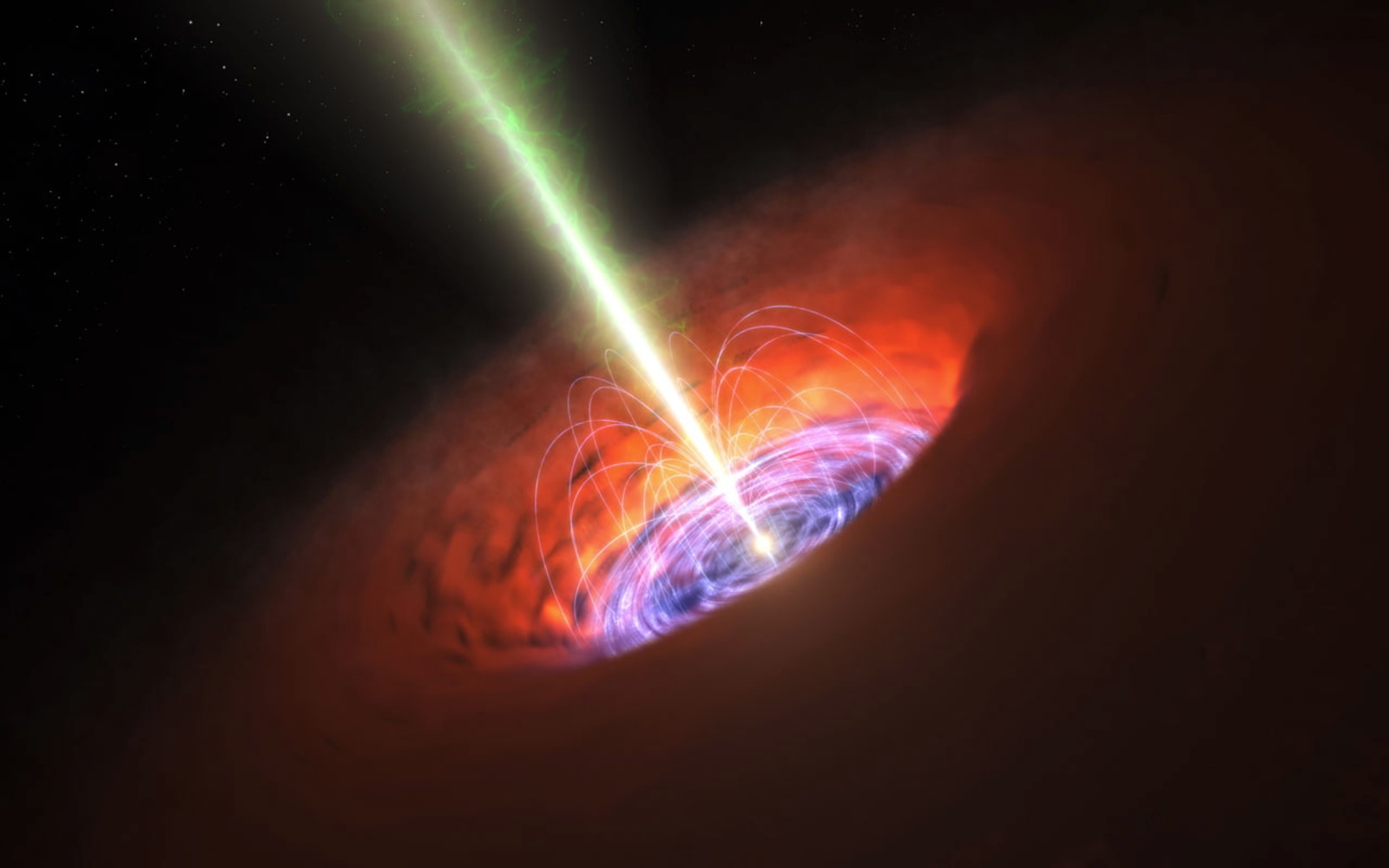
Image: Artist’s impression of surroundings of a supermassive black hole
This artist’s impression shows the surroundings of a supermassive black hole, typical of that found at the heart of many galaxies. ESO/L. Calçada
"The million-dollar question is whether all the information is stored in this way, and we have made no claims about that," said study author Andrew Strominger, a physicist at Harvard University in Massachusetts. "It seems unlikely that the kind of hair that we described is rich enough to store all the information." 
According to Einstein's theory of general relativity, black holes are extremely dense celestial objects that warp space-time so strongly that no light or matter can escape their clutches. Some primordial black holes formed soon after the Big Bang and may be the size of a single atom yet as massive as a mountain, according to NASA. Others form as gigantic stars collapse in on themselves, while supermassive black holes lie at the hearts of almost all galaxies. [8 Ways You Can See Einstein's Theory of Relativity in Real Life
In the 1960s, physicist John Wheeler and colleagues proposed that black holes "have no hair," a metaphor meaning that black holes were shorn of all complicated particularities. In Wheeler's formulation, all black holes were identical except for their spin, angular momentum and mass. 
 Technology Gives Voice to the Voiceless 1:27
Then, in the 1970s, Stephen Hawking proposed the notion now called Hawking radiation. In this formulation, all black holes "leak" mass in the form of ghostly quantum particles that escape over time. Eventually, Hawking radiation causes black holes to evaporate altogether, leaving a single, unique vacuum. The vacuums left by these black holes, according to the original theory, would be identical, and thus incapable of storing information about the objects from which they were formed, Strominger said. 
Since the Hawking radiation leaking from a black hole is completely random, that would mean black holes lose information over time, and there would be no way of knowing much about the celestial objects that formed the black holes. Yet that notion creates a paradox, because on the smallest scale, the laws of physics are completely reversible, meaning information that existed in the past should be theoretically recoverable. In recent years, Hawking has walked back the notion of information loss and conceded that black holes do store information after all
In the past several years, Strominger has been dismantling some of these notions. First, he asked the question: What happens if you add a "soft" photon, or a particle of light with no energy, to the vacuum left behind after a black hole evaporates?
Though most people have never heard of soft photons, the particles are ubiquitous, Strominger said. (Other particles, called soft gravitons, are hypothetical quantum particles that transmit gravity. Though they have never been detected, most physicists believe these particles exist and are also incredibly abundant, Strominger said). [Beyond Higgs: 5 Other Particles That May Lurk in the Universe]
"Every collision at the Large Hadron Collider produces an infinite number of soft photons and soft gravitons," Strominger said. "We're swimming in them all the time."
After working through the equations, he — together with Hawking and Malcolm Perry, who are both physicists at the University of Cambridge in England — found that the black hole vacuum would have the same energy but different angular momentum after the addition of a soft photon. That meant the vacuum state of an evaporated black hole is a kind of celestial snowflake, with its individual properties dependent on its origin and history.
"Far from being a simple, vanilla object, it's like a large hard drive which can store essentially an infinite amount of information in the form of these zero-energy photons and gravitons," Strominger told Live Science.
The new work is an extension of a short paper Hawking put out in 2014, which argued that the event horizon, or the point of no return before an object would get swallowed into a black hole forever, may not be a fixed boundary. The new paper posits that hairs of soft photons and gravitons fringe a black holes' event horizon.
Source : livescience

Wednesday, January 13, 2016

Using mutant mosquitoes to kill malaria can be dangerous for humans


Sickle-cell anaemia is an inherent genetic disorder prevalent mostly among the Sub-Saharan population. It is caused by an abnormality in the oxygen-carrying protein in blood - S. Haemoglobin. Due to a malformed genetic codes, the haemoglobin present in people suffering from this disorder is defective.
As a result, the protein undergoes structural changes and the Red blood cells (RBCs) look sickle-shaped. This further exposes those that are affected by the disorder to a high risk of cardiovascular and vaso-occlusive diseases. And, in turn, leads to high child mortality rate within the Sub-Saharan population.
A strange, but important part of this disease, is that this genetically varied population affected by sickle cell anaemia is resistant to malaria. Given the fact that nearly two million people die of malaria annually, and ninety per cent are from the Sub-Saharan belt, scientists and microbiologists have been trying for decades to figure out the root of this resistance.
Some of them are of the view that the disease is a classic example of Darwin’s theory of natural selection and the theory of adaptability of organisms to their environment. It is a way by which nature helps in developing immunity against whatever is destructive in the immediate environment, but in the process, also forces the body to biologically compensate otherwise.
In this case, sickle-cells that may be resistant to malaria, but are malformed and are at a higher risk of developing other blood-related disorders. In the grand scheme of things it can be said that nature has its own way of imposing compensation.
Last month when scientists at the University of California successfully engineered a breed of Anopheles mosquito (Anopheles stephani) that’s supposed to be genetically resistant to malaria, they perhaps had no idea that in a few weeks' time, people at the Imperial College London (ICL) would come up with another breed that wouldn’t even need to resist.
This new breed of genetically modified mosquito called Anopheles gambiae is engineered to be infertile and pass down the trait rapidly. Through a technology called Gene Drive, scientists at the Imperial College are working at accelerating the process of passing down of the gene to the offsprings so that the breed of female Anopheles, the carrier for the malaria parasite, is wiped out soon.
Molecular biologists Tony Nolan and Andrea Crisanti at the ICL have identified three genes that code for fertility in the Anopheles species. These genes could be targeted to be modified and introduce infertile variants into the population.
They have also claimed that they are looking for other genes that could code for fertility and in the process they would aim to modify every gene that is responsible for passing down of the trait. While the process may take a long time, it is expected that the breed of Anopheles mosquito can be successfully eliminated from the environment in the next ten years.
So, like smallpox and polio, malaria too can be expected to be eradicated in a decade or so.
While there are 3,400 species of mosquitos worldwide, Anopheles is only one among the 800 species of mosquitos found in Africa. So eliminating them from the food chain will not significantly affect the eco system, says Tony Nolan.
But as Professor Austin Burt from the Department of Life Sciences at ICL says, it will take a long series of trials and control experiments to figure out a successful elimination plan. It might even be a concern, adds Kevin Esvelt from Harvard, that the mosquito as well as the parasite may develop resistance against the modification and the process employed for elimination.
Though in this process, artificial selection is given privilege over Darwin's theory of natural selection, it's been observed, as in the case of sickle-cell anaemia that nature schemes out its own evolutionary processes to compensate the lack created in the ecosystem.
Though Anopheles contributes to a small percentage of the population of mosquitos worldwide, it still is a significant entity in the food chain. Elimination of anything from the food chain will create a lack, however minute, and most of the times an ecological lack leads to mutative traits in the organism targeted or in other related species of the same.
This further could lead a pathogenically evolved mosquito and may put some other population at a higher risk. It could be drawn as a caveat that micro-organisms have a high mutation rate when it comes to their virulence. Therefore, it can be expected that while the process of elimination may take a decade or so, during this time another strain of the malaria parasite may make its appearance in the scene.
Therefore, scientists aiming at the eradication of malaria, not only have to check the control trials at genetically modifying the Anopheles gambiae, but also have to ensure that the parasite, Plasmodium, does not find expression in other organisms as mutated strains.
We do not know how far artificial selection will take us, but while expecting for the elimination of the disease one needs to be doubly aware of the consequences that nature may seek to impose compensation on the human population.
Source : dailyo.in